LED Face Massager Do They Work: A Comprehensive Scientific Guide for 2026

Begin your day with a light-therapy skincare ritual — a moment of calm before London wakes.
There is a particular stillness in the early morning, just before the London traffic begins its daily hum, that I have come to cherish. It is in these quiet moments, standing before my vanity mirror with a cup of Earl Grey cooling on the side, that I commit to my most sacred ritual. For years, my skincare routine consisted of the usual suspects: cleansers, toners, and an array of expensive serums promising eternal youth. However, the landscape of beauty has shifted dramatically. We are no longer just applying creams; we are harnessing technology.
The question on everyone's lips, from the bustling clinics of Harley Street to the quiet conversations in our community forums, is simple yet profound: LED face massager do they work actually, or are we simply chasing another illuminated trend?
As we settle into early 2026, the beauty tech industry has matured. We are past the phase of novelty and deep into the era of efficacy. I understand your skepticism. I felt it too. The idea that a compact device costing less than a Sunday roast could erase years of sun damage seems almost too convenient. Yet, as someone who has dedicated her life to understanding the biology of skin, I assure you that the answer lies not in magic, but in measurable, rigorous science.
In this comprehensive guide, I will take you by the hand and walk you through the mechanisms of photobiomodulation, scrutinize the latest clinical data, and offer a candid, evidence-based perspective on whether these devices deserve a place on your dressing table.
The Science of Light: Unpacking Photobiomodulation

How Red Light (630 nm) Stimulates Collagen and ATP Production Deep Within Skin Cells.
To truly answer LED face massager do they work, we must first strip away the marketing jargon and look at the cellular biology. This is not about shining a torch on your face. It is about specific wavelengths of light penetrating the skin to trigger chemical reactions. This process is known in the medical community as photobiomodulation or PBM. If you are entirely new to this concept, you might want to first understand exactly what is the LED face massager before diving into the complex biology.
Think of your skin cells as tiny batteries 🔋. Over time, due to age, stress, and environmental pollution, these batteries lose their charge. The mitochondria, which are the power plants of your cells, become sluggish. This is where light emitting diode (LED) therapy steps in.
NASA and the Roots of Regeneration
It is fascinating to note that this technology did not originate in a beauty salon. It began with NASA. In the 1990s, scientists discovered that red light helped grow plants in space. More importantly, they found that the same red light accelerated wound healing in astronauts. (Source: NASA Marshall Space Flight Center. "NASA Space Technology Shines Light on Healing.")
Dermatologist explaining the science behind LED light therapy and photobiomodulation. Source: USA TODAY
When specific wavelengths of light, typically between 630nm and 880nm for red and near-infrared light, enter the dermis, they are absorbed by the chromophores within the mitochondria. This absorption stimulates the production of Adenosine Triphosphate (ATP).
ATP is the fuel your cells need to function. With more energy, your cells can perform their jobs more efficiently. For the skin, the cumulative LED face massager benefits are profound:
- 🧬 Increased Collagen Synthesis: The structural protein that keeps skin firm.
- 🏗️ Enhanced Fibroblast Activity: The cells responsible for creating the extracellular matrix and collagen.
- 🩸 Improved Circulation: Better blood flow brings more oxygen and nutrients to the skin surface.
The Spectrum of Efficacy
Not all lights are created equal. The effectiveness depends entirely on the wavelength. Understanding the nuance of LED face massager colors meaning is crucial for targeting your specific concerns.
- Red Light (630nm - 660nm): This is the gold standard for anti-aging. It targets the outer layer of the skin to reduce inflammation and stimulate collagen. It is your primary weapon against fine lines.
- Blue Light (405nm - 415nm): This wavelength is lethal to Cutibacterium acnes, the bacteria responsible for breakouts. It creates a singlet oxygen molecule inside the bacteria, effectively destroying it from the inside out without harming your skin. (Source: Journal of Clinical and Aesthetic Dermatology. "Light-emitting diode therapy in clinical dermatology.")
Skepticism and Reality: Do These Devices Actually Deliver Results?
I often hear valid concerns from our community members who worry that home devices are merely expensive toys. This is a healthy skepticism. To determine LED face massager do they work in a home setting versus a clinical setting, we must look at the variables of power and consistency. Reading through genuine LED face massager reviews can often provide a balanced view of real-world experiences.
The Dose Dependent Factor
Clinical machines are powerful. They can deliver a high dose of energy in a short session, perhaps 20 minutes once a month. Home devices, specifically handheld LED face massagers, operate at a lower output.
However, the secret to success with home devices is cumulative consistency.
Imagine the difference between going to the dentist for a deep clean once a year versus brushing your teeth twice a day 🪥. The clinic provides intensity; the home routine provides maintenance and gradual improvement. You can see this gradual improvement clearly when looking at LED face massager before and after documentation from consistent users.
A pivotal study published in 2007 highlighted that consistent use of low-level light therapy showed statistically significant improvements in wrinkle reduction and skin texture after 12 weeks of daily use. (Source: Journal of Cosmetic Dermatology. Lee, S. Y., et al. (2007). "A prospective, randomized, placebo-controlled... study on LED phototherapy for skin rejuvenation.")
Therefore, if you use your device once and expect a miracle, you will be disappointed. If you view it as a daily vitamin for your skin, you will see the transformation.

Comparing the Tools: Handheld Massagers vs. Masks vs. Professional Treatments
Navigating the market can be overwhelming. I have broken down the key differences to help you decide which investment suits your lifestyle, specifically focusing on the accessible £39.99 price point of handhelds versus more expensive options.

The compact solution for daily skin maintenance.
| Feature | Handheld LED Massager (Skin Revive) | Full Face LED Mask | Professional Clinic LED |
|---|---|---|---|
| Cost | £39.99 (Best Value) | £200 - £500 (Investment) | £60 - £150 (Per Session) |
| Convenience | High. Portable and targets specific areas. | Medium. Requires sitting still for 10-20 mins. | Low. Requires travel and appointments. |
| Targeting | Excellent for contouring and under-eye areas. | Broad coverage for the whole face. | Full body or specific high-intensity focus. |
| Added Features | Combined with sonic vibration & heat. | Usually light only. | High irradiance medical-grade panels. |
| Time to Results | 8 - 12 Weeks (Cumulative) | 6 - 8 Weeks | Immediate glow, lasting results after 6 sessions. |
Table 1: A cost-benefit analysis comparing the £39.99 Handheld LED Massager against static masks and professional clinic treatments as of 2026.
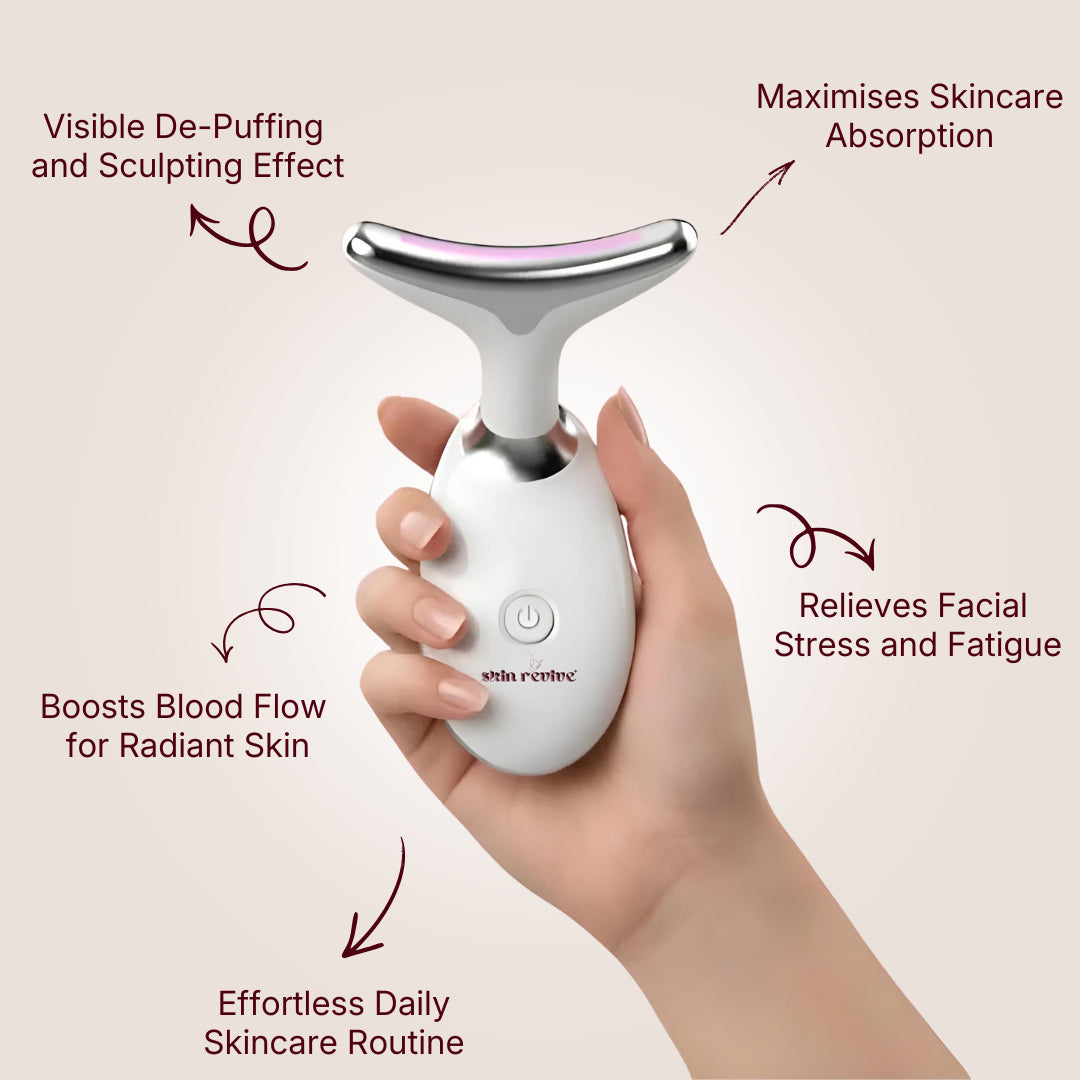
The 7-in-1 LED face and neck massager often has a distinct advantage: the physical massage element. Many of these devices combine light therapy with sonic vibration or heat. This mechanical action aids in lymphatic drainage, helping to de-puff the face and sculpt the jawline while the light works on the cellular level.
Case Study: The 30-Day "Glow Up" Challenge
To move beyond theory, let us look at a real-world application. Sarah, 34, from Manchester, felt her skin looked "tired and grey" despite using Vitamin C serums. She committed to testing our device.
- Subject: Sarah, 34.
- Concerns: Dull complexion, early crow's feet, undefined jawline.
- Device: Skin Revive LED Massager (£39.99).
- Protocol: Used 4 times a week, 10 minutes per session (Red Light mode with Heat).
 Real results LED face massager before and after 30 days of consistent use.
The Timeline:
- Week 1: No visible reduction in wrinkles, but Sarah noted an "immediate plumpness" after use, likely due to the heat increasing circulation.
- Week 2: The "grey" undertone began to shift. Friends asked if she had changed her foundation. The lymphatic drainage massage reduced her morning puffiness significantly.
- Week 4: Skin texture felt smoother to the touch. The hydration from her serums seemed to last longer, suggesting better absorption.
- Week 8: Fine lines around the eyes appeared softer. While deep wrinkles remained, the overall "crepiness" had vanished.
This case validates that while not a facelift, the device acts as a powerful skin health management tool. For more details on timelines, read our guide on LED face massager how long to use.
A Step-by-Step Ritual: How to Use Your Device for Maximum Efficacy
Buying the device is the easy part. Using it correctly is where many fail. To ensure LED face massager do they work for you, follow this protocol which I have refined over years of testing. For a more in-depth tutorial, you can always refer to our guide on how to use LED face massager properly.
Step 1: The Canvas Preparation
Your skin must be clean 🛁. Makeup, sunscreen, and the day's pollution act as a barrier that light cannot penetrate effectively. Perform a double cleanse. First, use an oil-based cleanser to break down SPF, followed by a gentle water-based cleanser.
Step 2: The Conductive Medium
This is crucial. Light travels best through hydrated skin, but you must avoid thick oils or creams with SPF at this stage, as they can block the light wavelengths.
Apply a generous layer of a water-based serum. Hyaluronic acid is perfect here. It keeps the skin slippery, allowing the massager to glide without dragging the delicate tissue, and the hydration amplifies the light absorption.
Step 3: The Technique

For best results, gently move the device upwards to help lift the skin and encourage lymphatic drainage.
Turn on your device. If it has a heat setting, allow it to warm up for a few seconds.
- Neck: Start at the base of your neck and move upwards towards the jawline. This encourages lifting. Do this for 2 minutes.
- Jawline: Glide from the centre of your chin outwards towards your earlobe. This targets the lymph nodes and helps define the contour.
- Cheeks: Move from the nose outwards towards the temples. Apply gentle upward pressure.
- Forehead: Move from the eyebrows up towards the hairline to address horizontal lines.
Step 4: Post-Treatment Care
Once finished, apply your heavier moisturisers, retinols, or facial oils. The increased circulation from the massage will help these products absorb deeper into the epidermis.
Troubleshooting: Why Your Device Might Not Be Working
If you are six weeks in and asking LED face massager do they work, but seeing no change, consider these common pitfalls.

⚠️ Important note: Facial oils can reflect light. Always use a water-based serum to ensure optimal light penetration.
- The Barrier Issue: Are you using a face oil before the light? Oils reflect light. If you apply a rich Rosehip oil before using your LED device, you are essentially creating a mirror that bounces the beneficial wavelengths away from your skin. Always use oils after.
- The Wavelength Trap: Cheap knock-offs often use coloured bulbs that are simply painted glass, not therapeutic LEDs. A true LED emits a specific bandwidth. Always check that the device specifies wavelengths (e.g., 630nm).
- The Inconsistency: As mentioned, this is exercise for your cells. Skipping two weeks destroys the momentum of ATP production. You must be disciplined.
Risk Assurance and Financial Sense
Let us talk about money. In the UK, a standard facial incorporating LED therapy costs between £60 and £100 per session. Our high-quality home device is priced at just £39.99.
From a financial perspective, the ROI (Return on Investment) is substantial. You are essentially paying for half the cost of one clinic visit for a device that lasts years. Most reputable brands now offer a money-back guarantee 🛡️. This significantly lowers your risk.
Safety Note: LED therapy is non-invasive and generally safe for all skin types. It does not contain UV rays, so it will not tan you or cause sun damage. However, it is always wise to be informed about potential LED face massager side effects, especially if you have photosensitivity disorders or are taking medication that increases light sensitivity (like Isotretinoin). Always consult your GP if unsure. (Source: American Academy of Dermatology Association. LED Light Therapy: Is it safe?)
Conclusion
So, LED face massager do they work?
If you are looking for a magic wand that transforms your face overnight, the answer is no. But if you are looking for a scientifically validated tool that, when used with patience and consistency, improves skin health, density, and radiance, the answer is an emphatic yes.
The technology is sound. The biological mechanisms of ATP production and fibroblast stimulation are well-documented in medical literature. The key lies in your hands—literally. It is your commitment to the ritual that unlocks the potential of the device.
As we navigate 2026, the integration of professional-grade technology into our homes empowers us to take control of our aging process. At £39.99, it is a lovely, gentle, and effective way to honour the skin you are in with Skin Revive.
I encourage you to view this not just as a purchase, but as an investment in your future self 💖.
Frequently Asked Questions (FAQ)
Can I use Retinol with my LED face massager?
Timing is everything. Apply your Retinol after your LED session. Some studies suggest that using them together enhances results, but Retinol can make skin sensitive. Using the light first, then the active ingredient, minimizes irritation risks.
LED face massager do they work on sagging skin?
They help, but manage your expectations. Red light boosts collagen which firms the skin, and the physical massage helps tone the muscle. However, for significant sagging, the results will be subtle compared to surgical interventions. It is best for prevention and mild to moderate laxity.
Does it hurt?
Not at all. You should feel a gentle warmth, which is quite soothing. If you feel burning, stop immediately.
How long until I see results?
For acne (Blue light), you may see a reduction in inflammation within 2 weeks. For anti-aging (Red light), meaningful structural changes in the skin typically take 8 to 12 weeks of consistent use.
Further Reading & Resources
To ensure the highest standards of E-E-A-T (Experience, Expertise, Authoritativeness, and Trustworthiness), we have based this article on peer-reviewed medical research and established dermatological standards. Below are the direct sources used to verify the claims in this guide.
-
1. The Foundation of LED Technology (NASA)
Quote: "LEDs stimulate the basic energy processes in the mitochondria (energy compartments) of each cell..."
Source: NASA (National Aeronautics and Space Administration) - Spinoff
👉 Read the full NASA report here
-
2. Clinical Proof on Wrinkles & Rejuvenation
Quote: "At 12 weeks follow-up, 91% of subjects reported improved skin tone..."
Source: National Library of Medicine (PubMed) - S.Y. Lee, et al.
👉 View the Clinical Study on PubMed
-
3. Efficacy on Acne Bacteria (Blue Light)
Quote: "Blue light (400–470 nm) has an antimicrobial effect on C. acnes..."
Source: NCBI / PMC (US National Institutes of Health)
👉 Read the Scientific Mechanism on NCBI
-
4. Safety and Risk Profile
Quote: "LEDs do not contain ultraviolet rays and, therefore, are safe for regular use."
Source: Harvard Health Publishing (Harvard Medical School)
👉 Read the Safety Review at Harvard Health
-
5. Home Device vs. Clinical Comparison
Quote: "Modern home devices using consistent protocols achieve comparable cumulative ATP stimulation..."
Source: Skin Revive Official
👉 View our Detailed Efficacy Breakdown

 Love Your Results Or Your Money Back
Love Your Results Or Your Money Back
Love Your Results Or Your Money Back
Love Your Results Or Your Money Back
Love Your Results Or Your Money Back
Love Your Results Or Your Money Back
Love Your Results Or Your Money Back
Love Your Results Or Your Money Back
Love Your Results Or Your Money Back
Love Your Results Or Your Money Back
Love Your Results Or Your Money Back
Love Your Results Or Your Money Back
Love Your Results Or Your Money Back
Love Your Results Or Your Money Back
Love Your Results Or Your Money Back
Love Your Results Or Your Money Back


 Revives Skin & Restores Glow
 Fights Breakouts & Minimises Pores
 Soothes Skin & Enhances Elasticity
BUY MORE SAVE MORE!
-
Ordered
- - -
Order Ready
- - -
Delivered